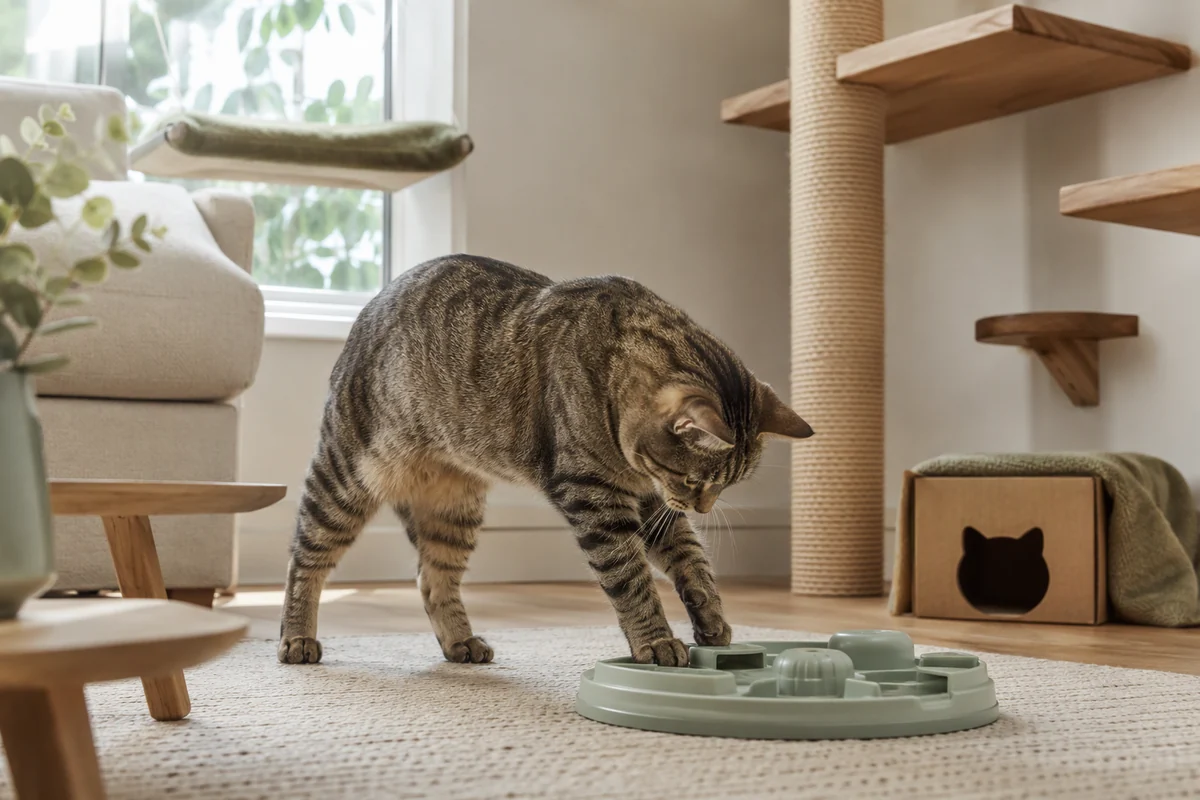
Cat enrichment means giving your cat safe opportunities to climb, hide, scratch, hunt, play, explore, forage and choose where to rest. A good setup combines a cat-friendly home with short daily play sessions and varied activities. Indoor cats can live enriched lives without roaming, but they need enough space, resources and positive interaction to meet their natural behavioural needs.
Quick takeaways
- Enrichment is more than a basket of toys: space, choice, routine and access to resources matter.
- Give cats safe places to climb and hide, plus suitable scratching surfaces near the places they already use.
- Use short play sessions that let your cat stalk, chase and catch a physical toy.
- Food puzzles should use part of the normal daily ration and start easy.
- In multi-cat homes, duplicate important resources in separate locations to reduce competition.
- New hiding, overgrooming, aggression, appetite changes or toileting changes warrant veterinary advice—not just more toys.
What is cat enrichment?
Cat enrichment is the combination of environmental features, activities and social experiences that allow a cat to express natural behaviours and engage their body, mind and senses. It includes obvious activities such as chasing a wand toy, but also quiet choices such as resting on a high perch, retreating into a box or watching birds from a secure window.
An enriched home is not necessarily full of expensive equipment. A stable scratching post, a cardboard box, a sunny bed and five minutes of thoughtful play may be more useful than a pile of toys your cat ignores.
The best enrichment is cat-led. Offer an activity, observe the response and let your cat opt out. What entertains one cat may worry or frustrate another.
Why is cat enrichment important?
Cats have strong motivations to explore, climb, scratch, hunt, hide and investigate. A typical home can limit these behaviours unless an owner deliberately provides suitable outlets. Welfare guidance from the RSPCA links appropriate enrichment with positive wellbeing, relaxation, reduced stress and stronger bonds with caregivers.
Enrichment may reduce some boredom-related behaviours, but unwanted behaviour should not automatically be labelled boredom. Scratching is normal. Hiding can be a sensible way to feel safe. Toileting outside the tray, overgrooming, appetite changes, new aggression and reduced activity can all have medical or environmental causes that need proper assessment.
Seven types of cat enrichment
| Type | What your cat needs | Practical examples |
|---|---|---|
| Environmental | Interesting, safe places to move and rest | Cat tree, shelves, tunnel, cardboard box |
| Climbing and observation | Elevated vantage points and safe viewing | Window hammock, stable perch, enclosed catio |
| Hiding and security | Retreats where the cat can choose privacy | Covered bed, box on its side, quiet room |
| Hunting and play | Opportunities to stalk, chase, pounce and catch | Wand toy, tossed paper ball, toy search |
| Scratching and tactile | Suitable textures and full-body stretching | Sisal post, cardboard scratcher, textured bedding |
| Feeding and scent | Foraging, investigation and problem-solving | Puzzle feeder, kibble hunt, catnip for responders |
| Social and cognitive | Predictable interaction and achievable learning | Gentle training, grooming if enjoyed, calm play |
20+ cat enrichment ideas for indoor cats
Create a better environment
- Add a secure high perch: Give your cat a stable place to observe without being disturbed.
- Offer a cardboard retreat: Place a box on its side with a familiar blanket; do not block the exit.
- Create a window-watching spot: Use a closed, secure window and a stable bed or hammock.
- Use vertical routes: Arrange safe routes between floor, furniture and perches without forcing jumps that are too high.
- Provide several resting choices: Include warm, cool, high, low, open and covered options.
- Set up a tunnel: Use a sturdy cat tunnel or a safe box arrangement with multiple exits.
- Rotate a few toys: Keep some out of sight and swap them periodically rather than leaving everything on the floor.
Support scratching and natural movement
- Match the scratching surface: Try upright sisal, flat cardboard or angled surfaces and observe your cat’s preference.
- Put scratchers in useful locations: Place them near sleeping areas and the furniture your cat already targets.
- Choose stability: A post that wobbles may be ignored; it should allow a full, secure stretch.
- Build an easy indoor course: Use tunnels, perches and treats or toys to encourage voluntary exploration.
- Offer cat grass if approved: Use a pet-safe product and confirm plant safety with your vet; avoid unknown houseplants.
Play and problem-solving
- Wand-toy hunt: Move the toy like prey—away, behind cover and in short bursts—then let your cat catch it.
- Paper-ball chase: Toss a clean, loosely scrunched paper ball and remove it if it tears or your cat chews it.
- Toy hide and seek: Hide a favourite toy partly behind furniture and encourage investigation.
- Puzzle-feeder session: Start with food visible and use part of your cat’s normal meal.
- Kibble treasure hunt: Scatter a small amount in one safe room before progressing to a few hiding spots.
- Toilet-roll feeder: Fold the ends of a clean tube, add kibble and make suitable holes; supervise and discard if damaged.
- Clicker or target training: Teach a simple nose touch to a target using positive reinforcement.
- Catnip or silvervine trial: Offer a small amount on a suitable toy if your cat responds positively; not every cat responds.
- Gentle grooming: For cats that enjoy it, keep sessions short and stop at signs of discomfort.
- Safe outdoor enclosure time: Provide shade, water, hiding and climbing options in an escape-proof space.
For DIY safety principles and food-puzzle ideas, see the RSPCA’s low-cost enrichment guide.
A room-by-room indoor cat enrichment audit
Use this table to find one improvement in each area your cat can access. You do not need to change everything at once.
| Area | What to check | Simple improvement |
|---|---|---|
| Living room | Is there a high perch, hiding place and suitable scratcher? | Move a stable post near the sofa your cat scratches |
| Bedroom | Can your cat rest without being disturbed? | Add a covered bed or leave a safe box available |
| Windows | Are screens secure and is the perch stable? | Create a comfortable viewing spot away from direct overheating |
| Feeding area | Is it quiet and separated from litter trays? | Add an easy puzzle or split food into small, calm searches |
| Water stations | Are they accessible without passing another pet? | Add a separate bowl or fountain in a suitable location |
| Litter areas | Are trays private, accessible and free from ambush? | Provide enough trays in separate, low-stress locations |
| Hallways | Can another cat block the only route? | Create visual separation and alternative routes where possible |
| Balcony or yard | Is the area genuinely escape-proof and shaded? | Use a secure enclosure and remove toxic plants and hazards |
Free home-audit habit: Choose one row each weekend. Record what you changed and whether your cat used it. Keeping the changes that work is more useful than buying an entire new setup at once.
A simple weekly cat enrichment routine
Short, predictable sessions usually work better than one long weekend burst. Adjust the frequency and intensity for your cat’s age, health and interest.
| Day | Environment or feeding | Interactive activity |
|---|---|---|
| Monday | Easy puzzle with part of breakfast | 5–10 minutes of wand play with a catch |
| Tuesday | Refresh a window or hiding spot | Short target-training session |
| Wednesday | Small kibble treasure hunt | Paper-ball chase or toy search |
| Thursday | Rotate one or two toys | Gentle grooming if your cat chooses it |
| Friday | Try a different scratching texture | Wand play in a different room |
| Saturday | Secure enclosure time if available | Explore a tunnel or easy indoor course |
| Sunday | Repeat the week’s favourite | Quiet play and an undisturbed rest period |
Many cats benefit from more than one brief play opportunity each day. Watch your cat’s body language, stop before they become overwhelmed and always provide time to settle.
Cat enrichment for kittens, adults and seniors
Kittens
Use small, safe toys, easy puzzles and gentle social play. Kittens need plenty of sleep and should not be forced into prolonged handling or intense activity. Remove anything small enough to swallow and supervise closely.
Adult cats
Offer a mix of hunting play, climbing, scratching, exploration and problem-solving. Increase puzzle difficulty gradually and rotate activities based on observed preferences. An adult cat that suddenly stops playing should be checked for pain or illness.
Senior cats
Keep resources easy to reach and provide ramps or intermediate steps where needed. Use soft bedding, low-impact play and simple food puzzles. Arthritis, dental disease, sensory loss and cognitive changes can alter what feels comfortable, so ask your vet how to adapt the setup.
Enrichment in multi-cat homes
A larger toy collection does not solve competition over space. Each cat needs safe access to key resources without being forced past another cat.
Cat Friendly Homes recommends separate safe places and important resources, with visual separation where needed. A practical starting point is:
- separate food and water stations;
- enough litter trays in different locations;
- multiple scratching surfaces;
- several high perches and hiding places; and
- individual play when cats compete for toys.
Watch for subtle tension such as staring, blocking doorways, guarding resources, avoidance or one cat stopping using a room. Do not punish these behaviours. A vet can rule out medical causes and advise on environmental or behaviour support.
Safe outdoor enrichment without roaming
Outdoor sights, smells and textures can be enriching, but free roaming exposes cats to risks and can harm wildlife. Australian welfare guidance supports containment to the owner’s property, with a secure outdoor enclosure where possible.
Options include:
- an escape-proof catio with shade, water, hiding and elevated resting areas;
- a professionally cat-proofed yard;
- supervised time in a secure enclosure; or
- gradual harness training for a confident cat, using a properly fitted harness and a safe location.
Check local council containment rules and never leave a cat in a hot, exposed enclosure. A new outdoor space should be introduced gradually, with an easy route back indoors.
Cat toy and enrichment safety
The RSPCA warns that toys can pose ingestion, choking and entanglement risks, and notes the absence of standardised safety regulations for cat and dog toys in Australia.
- Supervise new toys and DIY projects. Remove them after the activity unless you know independent use is safe.
- Avoid string-like hazards. Yarn, ribbon, tinsel, dental floss and rubber bands can be dangerous if swallowed or tangled.
- Check small parts. Bells, feathers, eyes and other attachments can detach.
- Use stable furniture. Perches and posts should not tip during jumping or scratching.
- Keep food within the daily ration. A puzzle is a different way to serve food, not a reason to add unlimited treats.
- Respect stress signals. Hiding, flattened ears, dilated pupils, swishing tail, growling or trying to escape means stop and give space.
- Inspect and clean. Replace damaged toys and clean food-contact items after use.
Contact a vet promptly if your cat may have swallowed part of a toy. If string or a similar object is hanging from the mouth or bottom, do not pull it; seek immediate veterinary advice.
How to choose cat enrichment products
Before buying, ask what behaviour the product supports and whether your home already meets that need.
| Product type | Best suited to | What to check |
|---|---|---|
| Wand toy | Interactive stalking and chasing | Secure attachments, safe length, storage out of reach |
| Puzzle feeder | Foraging and problem-solving | Adjustable difficulty, washable surfaces, suitable food size |
| Scratching post | Stretching and normal scratching | Stability, height, preferred texture and useful placement |
| Cat tree or shelves | Climbing, observation and retreat | Weight rating, secure installation and accessible routes |
| Tunnel | Hiding, chasing and exploration | Sturdy material, ventilation and more than one exit |
| Window perch | Safe visual stimulation | Secure mounting, screen safety and protection from overheating |
Add one item with a purpose: Browse Zookie’s cat toys and enrichment range and use the table to match a product to your cat’s behaviour—not just its colour or popularity.
Frequently asked questions
Do indoor cats need enrichment?
Yes. Indoor containment can protect cats from roaming risks, but the home still needs to provide opportunities for play, climbing, scratching, hiding, exploration and positive social interaction. A safe home should also be a behaviourally suitable one.
How do I enrich my cat’s environment without buying toys?
Use a secure box, create a safe window spot, offer different resting places, hide part of the normal meal in one room, play with a clean paper ball and rotate existing toys. Your interaction and the arrangement of the home are as important as purchased items.
What is the best enrichment for cats?
There is no universal best option. Many cats benefit from interactive hunting play, stable climbing and scratching areas, safe hiding places and easy food puzzles. The best choice is one your individual cat uses willingly and safely.
Can cats play with cardboard boxes?
Yes, many cats enjoy hiding, sitting and investigating in boxes. Remove staples, tape and labels, keep exits open and discard the box if it becomes damp, damaged or your cat eats the cardboard.
Does watching out the window count as enrichment?
It can provide visual and sensory stimulation for a cat that enjoys it. Make sure the window and perch are secure, and watch for frustration if your cat becomes agitated by animals outside.
Is cat TV good enrichment?
Some cats may enjoy short videos of suitable movement and sounds, while others ignore them or become frustrated. It should not replace physical play, exploration or social interaction. Stop if your cat seems stressed or tries to attack the screen. See our balanced cat TV and enrichment-video guide for evidence limits, setup and alternatives.
My cat is bored but will not play. What should I do?
Try a different toy, movement style, time or location, and keep sessions short. If the loss of interest is new or accompanied by hiding, appetite, grooming, mobility or toileting changes, arrange a veterinary check rather than assuming boredom.
Sources and further reading
- RSPCA Knowledgebase: Low-cost DIY enrichment for cats and dogs
- RSPCA Pet Insurance: DIY cat enrichment and safe toy ideas
- Cat Friendly Homes: Playing with your cat
- Cat Friendly Homes: Considering another cat and household resources
- RSPCA WA: Safe outdoor containment and enclosures
This article provides general information, not a diagnosis or individual behaviour plan. Have the published version reviewed by a registered veterinarian or appropriately qualified feline behaviour professional. Seek veterinary advice for health concerns, sudden behaviour changes or suspected ingestion.