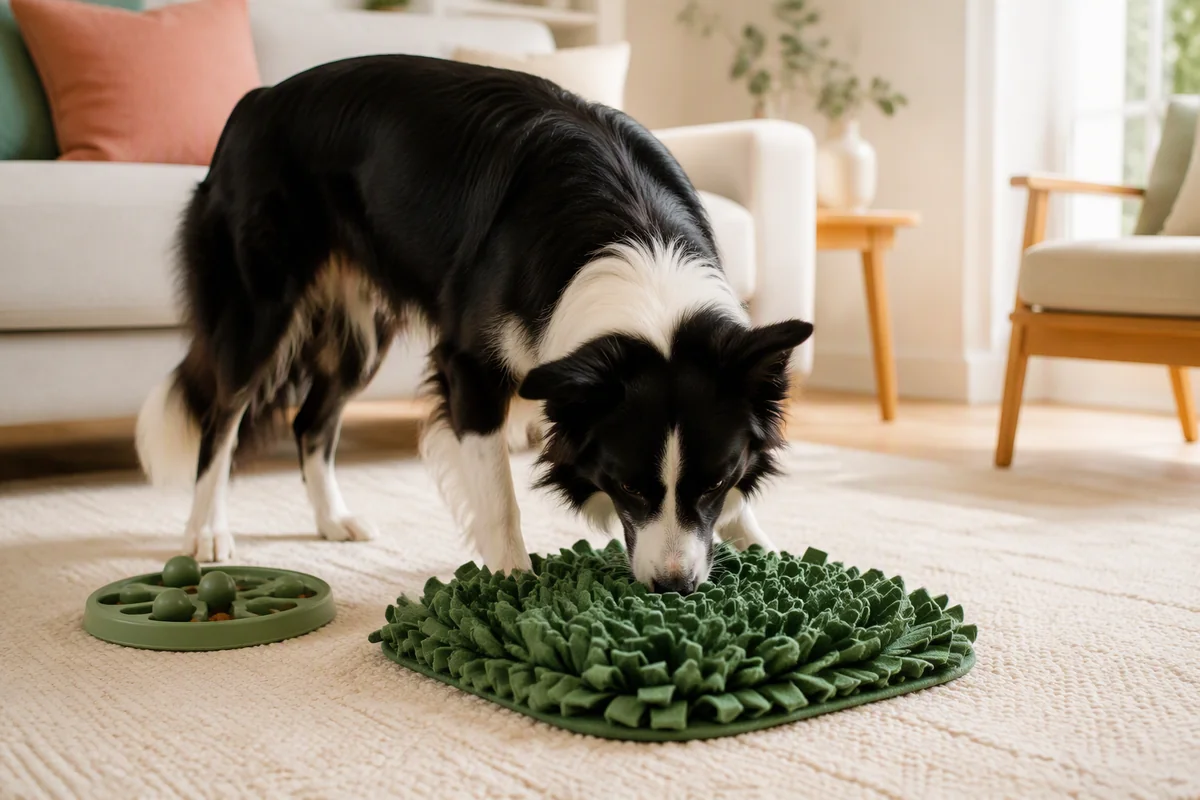
Dog enrichment means giving your dog safe opportunities to sniff, explore, play, chew, solve problems, socialise and make choices. It supports both mental and physical wellbeing. The best enrichment plan uses your dog’s normal food allowance, matches their age and health, and mixes different activities rather than relying on one toy or an extra-long walk.
Start here: Choose one activity from the seven-day planner, supervise it, and note what your dog enjoys. You do not need to buy a box of new toys.
Quick takeaways
- Enrichment is about meeting behavioural needs, not simply keeping a dog busy.
- Sniffing, training, foraging, play and calm social interaction all count.
- Use part of your dog’s daily food allowance for food puzzles rather than adding unlimited treats.
- Start easy, supervise new activities and remove damaged or unsafe items.
- A sudden behaviour change can have a medical cause; enrichment is not a substitute for veterinary care.
What is dog enrichment?
Dog enrichment is anything that gives a dog appropriate mental, physical or sensory stimulation and opportunities to express natural behaviours. That can include searching for dinner, learning a new cue, exploring a quiet walking route, playing with a person, or choosing between a sunny bed and a cool floor.
The RSPCA describes enrichment as essential to dogs’ physical and mental health. It can involve interactions with people and other animals as well as objects and environments. A cardboard box can be enrichment; so can five minutes of reward-based training or a relaxed sniffing walk.
Enrichment is not about constant excitement. More activity is not always better. Dogs also need uninterrupted rest, predictable routines and the ability to move away from an activity they do not enjoy.
Why is dog enrichment important?
A suitable enrichment plan can help a dog:
- express natural behaviours such as sniffing, chewing, digging and exploring;
- use their brain and body in a constructive way;
- experience variety and appropriate choice;
- build positive associations with people, handling and new experiences; and
- settle after an activity they find satisfying.
Research and welfare guidance link appropriate enrichment with relaxation, reduced stress and a reduction in some boredom-related behaviours. However, enrichment is not a cure-all. Barking, destructive chewing, withdrawal or restlessness can also be caused by pain, fear, separation-related problems, inadequate exercise or insufficient sleep. If a behaviour is new, severe or getting worse, arrange a veterinary check before simply adding more activities.
Six types of dog enrichment, with examples
| Type | What it gives your dog | Easy examples |
|---|---|---|
| Scent and sensory | Opportunities to investigate smells, sounds, sights and textures | Sniffing walk, treat search, safe surfaces, snuffle mat |
| Cognitive and training | Problem-solving, learning and memory work | Name a toy, short cue practice, simple puzzle |
| Feeding and foraging | Searching, chewing, licking and working for part of a meal | Puzzle feeder, muffin-tin game, food scatter |
| Physical and environmental | Movement and exploration in suitable places | New walking route, low obstacles, supervised digging area |
| Play | Chasing, tugging, retrieving or manipulating objects | Wand-style flirt pole, fetch, supervised tug |
| Social and calming | Positive interaction, companionship and choice | Grooming if enjoyed, relaxed training, sitting together |
One activity can cover several categories. A walk with time to sniff provides physical, environmental and scent enrichment. Training a dog to find a hidden toy combines cognitive, scent and social enrichment.
25 dog enrichment ideas you can try at home
You do not need all 25. Pick two or three that suit your dog, then rotate them with walks, rest and everyday interaction.
Free or low-cost ideas
- Sniffing walk: On a safe route, let your dog investigate suitable smells rather than aiming only for distance.
- Find the food: Scatter part of your dog’s normal meal in an open room or on untreated, dog-safe grass.
- Towel roll: Sprinkle kibble on a towel, roll it loosely and let your dog unroll it under supervision.
- Muffin-tin puzzle: Cover kibble in muffin cups with balls that are too large to swallow.
- Cardboard-box search: Hide food among safe, clean cardboard pieces; remove staples, tape and anything your dog tries to eat.
- Hide and seek: Ask a family member to hide, then call your dog once and reward the find.
- Toy name game: Teach a simple name for one toy and ask your dog to find it.
- Three-cup game: Hide a piece of kibble under one of three sturdy cups and let your dog indicate a choice.
- Indoor scent trail: Drag a favourite soft toy a short distance and hide it in an easy spot.
- Digging zone: Offer a designated box or patch of safe substrate for dogs that love to dig; supervise and keep it clean.
Training and problem-solving ideas
- Two-minute training: Practise one familiar cue and one easy new behaviour using positive reinforcement.
- Puzzle progression: Start with food visible, then gradually make the puzzle slightly harder.
- Which hand?: Let your dog sniff a closed hand containing food, then reward a gentle choice.
- Novel-object investigation: Place a safe household object on the floor and reward calm investigation.
- Settle on a mat: Teach your dog that relaxing on a mat earns calm reinforcement.
- Easy obstacle course: Use low, stable obstacles and non-slip flooring; avoid high jumps and slippery turns.
Play and sensory ideas
- Snuffle session: Use a clean snuffle mat with part of your dog’s meal.
- Supervised tug: Use a suitable toy, keep the game gentle and pause if your dog becomes over-aroused.
- Retrieve with breaks: Play a few repetitions rather than repetitive, high-intensity fetching.
- Flirt-pole play: Use low, controlled movements on non-slip ground and avoid abrupt twisting.
- Frozen food activity: Freeze a suitable portion of your dog’s normal wet food in a pet-safe feeder.
- Texture tour: Offer safe surfaces such as grass, rubber matting and firm carpet on a calm walk or in the yard.
- Quiet window choice: For dogs that enjoy watching without barking or lunging, provide a comfortable observation spot.
- Calm grooming: If your dog enjoys handling, use a short session with pauses and choice.
- Toy rotation: Put a few toys away and reintroduce them later instead of leaving every toy out permanently.
For step-by-step projects, see our guide to safe DIY dog enrichment toys.
A simple 7-day dog enrichment schedule
Use this as a starting point, not a rigid prescription. Adjust the duration and difficulty for your dog’s health, confidence and daily exercise. Food used in games comes from the day’s normal ration.
| Day | Short activity | Later activity | What to observe |
|---|---|---|---|
| Monday | 5-minute training refresher | Relaxed sniffing walk | Which rewards and pace work best? |
| Tuesday | Muffin-tin puzzle | Calm play or grooming | Can your dog solve it without frustration? |
| Wednesday | New quiet walking route | 5 minutes of settle practice | Does your dog explore and recover calmly? |
| Thursday | Towel-roll forage | Toy-name game | Does your dog prefer searching or play? |
| Friday | Easy indoor scent trail | Suitable tug or retrieve | Are the rules of play clear? |
| Saturday | Supervised digging or outdoor exploration | Quiet puzzle feeder | Does the activity help your dog settle afterwards? |
| Sunday | Repeat your dog’s favourite | Rest and toy rotation | Which activities deserve a place next week? |
Save this planner: Record the activity, duration, your dog’s response and whether they settled afterwards. A short note makes the next week easier to personalise.
Enrichment for puppies, adult dogs and seniors
Puppies
Keep activities short, easy and positive. Puppies need substantial sleep, so enrichment should not become nonstop stimulation. Use safe chewing outlets, tiny training sessions and gentle exposure to everyday surfaces, sounds and handling. Choose toys sized for the puppy and supervise anything that can be shredded or swallowed.
Adult and working-breed dogs
Healthy adult dogs may enjoy more complex problems, longer scent searches and active play. Working breeds often benefit from having a repeatable “job”, such as finding a toy, learning a routine or completing a suitable training sequence. Breed tendencies are a starting point, not a guarantee; the individual dog’s preferences matter more.
Senior dogs
Choose low-impact activities and avoid slippery flooring, high obstacles and frustrating puzzles. Short sniffing walks, easy food searches, gentle training and comfortable sensory experiences can work well. Ask your vet which activities are appropriate if your dog has arthritis, vision or hearing loss, heart disease or cognitive changes.
Dog enrichment for apartments and busy households
A small home can still provide good enrichment. Use vertical space only where safe, keep floors non-slip and rotate compact activities rather than storing dozens of toys. A useful weekday pattern is:
- a morning toilet break and sniffing walk;
- a small part of breakfast in an easy puzzle;
- a quiet, safe resting area while you work;
- an evening walk or play session; and
- two minutes of training followed by calm downtime.
Do not leave a new DIY item, soft toy, rope or food puzzle with loose parts for an unsupervised dog. Enrichment also cannot compensate for being left alone longer than the dog can comfortably manage. A trusted walker, day care or a qualified behaviour professional may be more appropriate in some households.
Our Australian apartment pet guide covers space, routine and neighbour considerations in more detail.
How to choose dog enrichment toys
The best dog enrichment toy is one your dog can use safely, understands and chooses to engage with. Before buying or making one, check:
| Question | What to look for |
|---|---|
| Is the size safe? | No choking-sized parts; balls and chew items appropriate for your dog’s mouth |
| Will it withstand this dog’s play style? | Durable materials for shredders; no brittle plastic, loose squeakers or sharp edges |
| Can it be cleaned? | Smooth, washable food-contact surfaces and no inaccessible old-food traps |
| Is the difficulty adjustable? | An easy starting level and a way to increase challenge gradually |
| Does it suit the activity? | Puzzle for problem-solving, snuffle mat for foraging, chew item for chewing—not one toy for every need |
| Can you supervise its introduction? | Especially important for DIY, soft, rope or small-part items |
Ready to add one useful tool? Browse Zookie’s dog and cat enrichment toys and use the checklist above to choose for your dog’s size, play style and experience—not just the product label.
Dog enrichment safety rules
The RSPCA notes that there are no standardised safety regulations for cat and dog toys in Australia, so owners need to assess each item and activity carefully.
- Supervise new activities. Watch how your dog interacts with the item before considering longer or independent use.
- Count the calories. Use part of the daily food allowance; enrichment should not accidentally become an extra meal.
- Remove hazards. Avoid staples, tape, sharp edges, small detachable parts and materials your dog tries to swallow.
- Make it easy at first. Frustration, pawing desperately or giving up means the puzzle needs simplifying.
- Use safe food. Avoid toxic ingredients and check with your vet if your dog has allergies or a prescribed diet. See toxic foods for dogs and cats.
- Avoid heat and overexertion. In Australian hot weather, choose cooler times and calm indoor activities; flat-faced, older and unwell dogs may need extra caution.
- Respect choice. Do not force a worried dog to interact with a toy, sound, animal or person.
- Inspect and clean. Discard damaged items and clean food toys after use according to their materials.
Contact your vet promptly if your dog may have swallowed part of a toy, is choking, has repeated vomiting, seems painful, collapses or has difficulty breathing.
Signs your enrichment plan needs adjusting
There is no universal checklist for a “bored” dog. Instead, compare your dog with their own normal behaviour. You may need to adjust the plan if your dog:
- loses interest because every activity is the same;
- becomes frantic rather than calmly engaged;
- gives up because the puzzle is too difficult;
- guards food toys from people or other pets;
- cannot settle after high-arousal games; or
- starts showing new destructive, repetitive or withdrawn behaviour.
Reduce competition by separating pets for food activities. Lower the difficulty, shorten the session and choose a different reward or activity. Persistent or escalating behaviour concerns deserve veterinary advice and, where needed, referral to a qualified behaviour professional who uses reward-based methods.
Frequently asked questions
Do dog enrichment toys work?
They can, when the toy matches the dog’s preferences, is safe and is set at an achievable difficulty. A toy is only one form of enrichment; it does not replace exercise, social interaction, training, rest or veterinary care.
How much enrichment does a dog need each day?
There is no single number that suits every dog. Start with one or two short activities alongside appropriate exercise and rest, then watch your dog’s response. Age, health, breed tendencies, confidence and daily routine all change the amount and intensity needed.
Is a walk enough enrichment for a dog?
A walk can provide excellent physical, sensory and environmental enrichment, especially when the dog has time to sniff. Many dogs also benefit from training, play, foraging and positive interaction. The right mix depends on the individual.
What can I do instead of food-based enrichment?
Try a sniffing walk, toy search, reward-based training, gentle play, a novel safe object, a digging area or calm grooming if your dog enjoys it. Non-food activities are useful for dogs on restricted diets or those that are not food-motivated.
Can I leave my dog with enrichment while I am at work?
Only leave items you know are safe for that particular dog to use unsupervised. New DIY projects, rope, soft toys and items with small parts require supervision. Enrichment may help during short alone periods, but it does not solve separation-related distress or replace appropriate company and breaks.
Is dog TV or a car ride enrichment?
It can be for some dogs, but watch the response. Relaxed looking or listening may be enriching; barking, pacing or avoidance means it may be stressful. A calm car ride to an enjoyable destination can provide novelty, while a worried dog may need gradual training instead.
Sources and further reading
- RSPCA Knowledgebase: Why is enrichment important for dogs?
- RSPCA Australia: The importance of enrichment for dogs
- RSPCA Knowledgebase: Low-cost DIY enrichment for cats and dogs
This article provides general information, not a diagnosis or individual behaviour plan. Have the published version reviewed by a registered veterinarian or appropriately qualified behaviour professional. Seek veterinary advice for health concerns, sudden behaviour changes or suspected ingestion.