A good cat massage takes five minutes, costs nothing, and is one of the fastest ways to lower your cat's stress — and yours. Here's exactly how to do it, which spots cats actually enjoy, and the warning signs that mean hands off.
Cats are famously selective about touch, so "cat massage" sounds like an oxymoron — until you realise cats massage each other constantly. Allogrooming (mutual licking and rubbing) is how bonded cats reinforce social bonds, and the right kind of human touch plugs straight into that same wiring. Done well, massage lowers cortisol, relaxes muscles, improves circulation and gives you a built-in weekly health check: your hands will find the lump, mat or sore spot long before your eyes do.
Done badly — wrong spot, wrong pressure, wrong moment — you'll get a swat and a cat that hides when you crack your knuckles. This guide keeps you firmly in the first camp.
Key takeaways
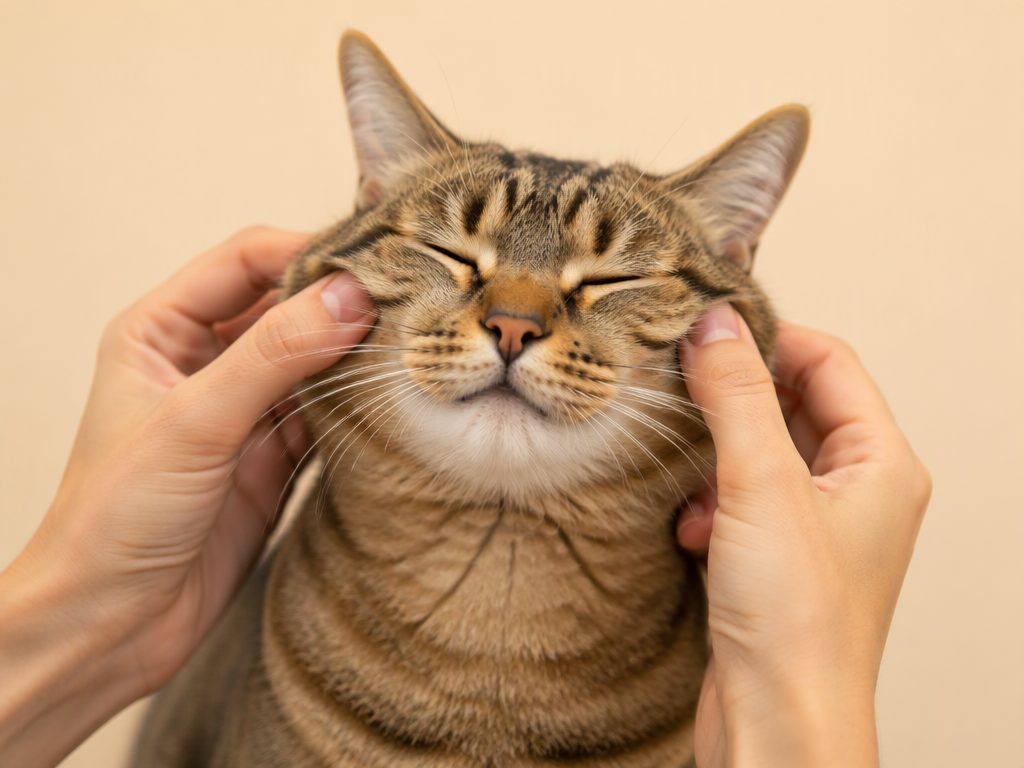
- Start with the chin, cheeks and behind the ears — the social scent zones. Belly and tail are off-limits for most cats.
- Two to five minutes, two or three times a week. Stop while your cat still wants more.
- Massage is wonderful comfort care for senior and arthritic cats, but it's a complement to vet care, never a substitute.
Why massage works for cats 🧠
Massage isn't indulgence — it's measurable physiology:
- Stress relief: gentle, predictable touch lowers cortisol and heart rate in both the cat and the person doing the stroking.
- Circulation and mobility: warmth and light pressure improve blood flow to muscles, which matters for older cats and couch-potato indoor cats alike.
- Bonding: touch at the scent-marking zones mimics social grooming — the feline equivalent of a hug.
- Early detection: regular hands-on sessions mean you'll notice new lumps, mats, weight loss, skin irritation or flinch points weeks earlier than you otherwise would.
The 5-step cat massage routine 👐
Total time: about five minutes. Pressure throughout: imagine stroking a butterfly off a flower — firm enough to be felt, light enough to be invited back.
| Step | What to do | Watch for |
|---|---|---|
| 1. Settle & scan | Approach a resting cat from the side; offer a hand to sniff. No hovering, no looming. | Relaxed body, slow blinks, ears up = green light |
| 2. Chin & cheeks | Slow fingertip circles under the chin, along the cheeks, behind the ears. | Leaning into your hand = continue; head turning away = pause |
| 3. Head & neck | Flat-finger strokes over the crown and down the back of the neck. | Eyes half-closing is the sweet spot |
| 4. Long back strokes | Flat hand from shoulders to hips, either side of the spine — never on it. 5–10 slow passes. | Skin rippling or tail starting to flick = wrap up |
| 5. Finish on a high | End on a favourite spot and stop while they still want more. | A cat that stays put and blinks at you is a cat that will queue up tomorrow |
Reading the room. Cats announce overstimulation before they act on it: a twitching tail tip, skin that ripples under your hand, ears rotating sideways, or a head that starts tracking your hand. Any of these means the session ends now — ending early is what makes the next session welcome.
Where cats love it — and where they don't 🗺️
| Zone | Verdict | Why |
|---|---|---|
| Chin & cheeks | ✅ Almost universally loved | Social scent glands — touch here reads as friendly grooming |
| Behind the ears | ✅ Loved | Scent zone again; hard for cats to groom thoroughly themselves |
| Top of head & back of neck | ✅ Usually loved | Mother cats carry and groom kittens here |
| Along the back (beside the spine) | ✅ Mostly liked | Long strokes mimic allogrooming; avoid direct pressure on the spine |
| Shoulders | 🟡 Cat-dependent | Some cats melt into shoulder circles; others find it too much |
| Paws & pads | 🟡 Rarely | Very sensitive; try one slow toe touch and accept the answer |
| Belly | ❌ No (even when shown) | An exposed belly is a trust display, not an invitation — most cats defend it on instinct |
| Tail & tail base | ❌ Avoid | Packed with nerves; overstimulation here is the classic swat trigger |
Massage for senior & arthritic cats 🧓
An estimated 60–90% of cats over ten have some arthritis, and Australian vets consistently flag it as one of the most under-treated conditions in cats — because cats hide pain so well. Gentle massage is one of the few home comforts that genuinely helps:
- Warm the muscles first with two minutes of flat-hand stroking before any focused work.
- Use feather-light pressure around hips and shoulders — you're soothing muscles, not manipulating joints. Never press on a joint itself.
- Short daily sessions (2–3 minutes) beat long weekly ones for chronic stiffness.
- Pair it with vet care. Massage works alongside modern treatments like Solensia (frunevetmab) injections and joint diets — ask your vet whether your senior is a candidate. If your cat flinches at being picked up, grooms one spot obsessively, or has stopped jumping to favourite perches, that's a vet visit first, massage second.
When massage is the wrong move ⛔
- Injury, swelling or an unknown lump — vet first, always.
- Pregnancy, fever, or a cat that has just eaten — skip it.
- Pain of unknown origin — a cat that suddenly hates being touched is telling you something. Massage can mask (or worsen) undiagnosed pain.
- A cat that says no. Flicking tail, rippling skin, flattened ears, walking off — the massage is over. Consent is the whole technique.
Want hands-on help from a professional? Small-animal myotherapy is a growing field in Australia — ask your vet for a referral to a qualified practitioner, especially for arthritis or post-surgical recovery.
Quick points to remember ✅
- ✓ Start at the chin and cheeks; keep pressure feather-light.
- ✓ 2–5 minutes, a few times a week — always end before they want you to.
- ✓ Belly and tail are no-go zones, no matter how they're presented.
- ✓ Flinching or a new lump = vet visit, not more massage.